
What Is Feng Shou Kung Fu?
Feng Shou Kung Fu, literally “Hand of the Wind”, is a distinctive style of Chinese martial arts and part of the Lee style Taoist arts. It is a comprehensive system of techniques and principles, which makes it a well-rounded form of self-defence and physical cultivation.
The Seven Key Components
1. Evasion
Evasion is the art of avoiding attacks. It is more than stepping out of the way: it means understanding your opponent’s intentions and energy, and using minimal movement for maximum effect (Wuwei), often turning their own force against them. Evasion in Feng Shou is subtle and fluid, in line with the Taoist principle of flowing with natural forces rather than against them.
2. Footwork (Foot Flows)
Footwork is an integral part of the art. It lets you keep your balance while moving quickly and efficiently, using steps, turns and shifts to change direction and position fast. This agility is crucial for both attack and defence, supporting evasion and the positioning needed for effective strikes or locks.
3. Arm Locks
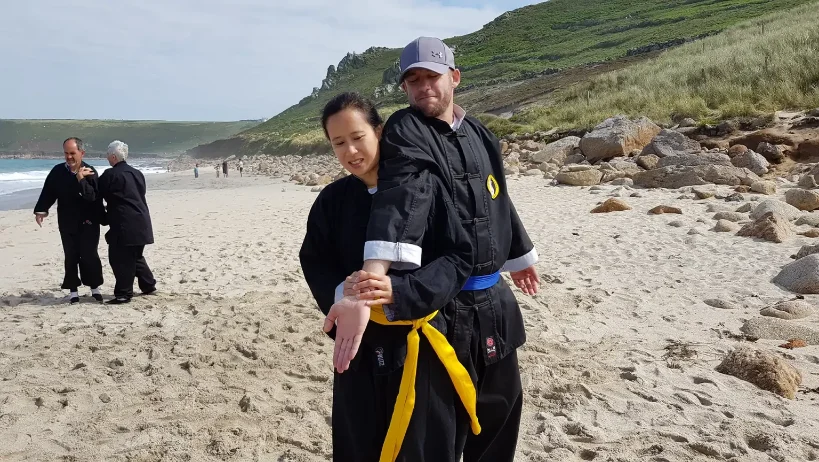
Arm locks immobilize or control an opponent by manipulating their arm joints. In Feng Shou they are applied with an understanding of the body’s mechanics and energy flow. As well as subduing an opponent, they can redirect their energy or create openings for further techniques.
4. Wrist Locks
Wrist locks work like arm locks but on the wrist joint, and they need precision and an understanding of leverage. They are used to control an opponent’s movements, lead them into a vulnerable position, or disarm them if they are holding a weapon.
5. Roll-aways
Roll-aways deflect or redirect an opponent’s force. They are based on using the opponent’s energy against them rather than meeting force with force. They combine hand movements and body positioning, often with stepping or turning to redirect the attack.
6. Grip and Breakout
This is about breaking free from an opponent’s grasp. It uses techniques for releasing yourself from holds and grabs, with leverage, pressure points and an understanding of body mechanics. The techniques are practical and efficient, and often lead straight into counterattacks or control techniques.
7. Forms
Forms are pre-arranged sets of movements that teach the basic principles of self-defence, such as stances, good posture, balance and co-ordination of upper and lower body techniques. They are practised to develop fluency, improve co-ordination and deepen your understanding of the principles behind the art. They range from basic sequences for beginners to more complex patterns for advanced practitioners, covering the full range of techniques in the style.
Qi, Balance and Taoist Principles
Every component is practised with an emphasis on internal energy (Qi), balance, and the Taoist principles of harmony and natural flow. Like other Taoist arts, Feng Shou Kung Fu is a spiritual practice as well as a physical discipline. It aims to balance and harmonize body, mind and spirit, which sets it apart from many other martial arts styles.
Four Core Principles
Softness and Using the Opponent’s Force
A central idea in Feng Shou is softness: yielding and flowing with an opponent’s force instead of opposing it with brute strength. It is rooted in Taoist philosophy, which values harmony with natural forces. Practitioners learn to sense the direction and strength of an attack and use it to their advantage, often turning the force back on the opponent. This takes a high level of sensitivity and control, and relies on skill and timing more than physical power.
Use of Qi Instead of Physical Strength
In line with Taoist practice, Feng Shou stresses cultivating and using Qi, or life energy, rather than relying only on muscle. Practitioners learn to channel Qi into their movements to make them more effective and efficient. This focus on internal energy gives the art its fluidity and power, so techniques can be done with minimal effort and maximum effect.
Circular Movements to Redirect and Recycle Force
Circular movements are central to both defence and attack in Feng Shou. They let practitioners redirect incoming force and use it to their advantage. They are also more than physical movements: they represent the Taoist idea of endless flow and the cyclical nature of the universe. With circular movements, practitioners can move smoothly from defence to attack, keeping a continuous flow of energy and motion.
Practical Self-Defence Orientation
Unlike many martial arts aimed at sport or competition, Feng Shou is focused on practical self-defence. Its techniques and principles are designed for real-world situations, with an emphasis on efficiency, adaptability and effectiveness. Training develops skills for a range of scenarios, with an emphasis on de-escalation, control, and being able to defend yourself without causing unnecessary harm.
In Summary
Feng Shou Kung Fu is a sophisticated, holistic martial art that combines physical techniques with deep philosophical insight. Its emphasis on softness, the use of Qi, circular movements and practical self-defence makes it a unique and effective system for physical and spiritual development, in keeping with the wider principles of Taoist philosophy.